
What if the value of wellbeing coaching isn’t a quick fix, but steady support that helps you turn an important goal into practical steps? If you’re asking, “is wellbeing coaching worth it?”, it’s reasonable to want to understand what the process can help with before investing your time, energy and money. You may also be wondering how coaching differs from other kinds of support, or whether a non-clinical approach fits what you’re facing.
Coaching can provide structure for working on personal goals, mindset, emotional regulation, focus and daily habits. Its value depends on how well the approach fits your circumstances and the effort you’re ready to put in between conversations. It can support your progress, but it can’t promise a particular outcome or replace therapy when clinical care is needed.
This guide will help you weigh potential benefits against the commitment involved, identify practical signs of progress and understand where coaching’s scope begins and ends. You’ll have a clearer basis for deciding whether it suits your goals.
Key Takeaways
- Assess whether wellbeing coaching fits a goal that matters to you, rather than expecting a guaranteed result.
- See how shared goal-setting and regular reflection can turn broad intentions into practical next steps.
- Compare coaching with self-guided change and therapy to understand which kind of support may suit your circumstances.
- Use four questions about your goal, readiness, progress and commitment to decide whether is wellbeing coaching worth it for you.
- Explore how Flourish Holistic Coaching offers personalised, non-clinical support focused on mindset, emotional regulation, focus and habits.
Is wellbeing coaching worth it when you want meaningful change?
When you’re considering investing time, energy and money, it’s sensible to ask what wellbeing coaching might help you work towards. A useful way to judge its value is to look for progress towards goals that matter to you, rather than expecting a guaranteed result or a complete change in how you feel.
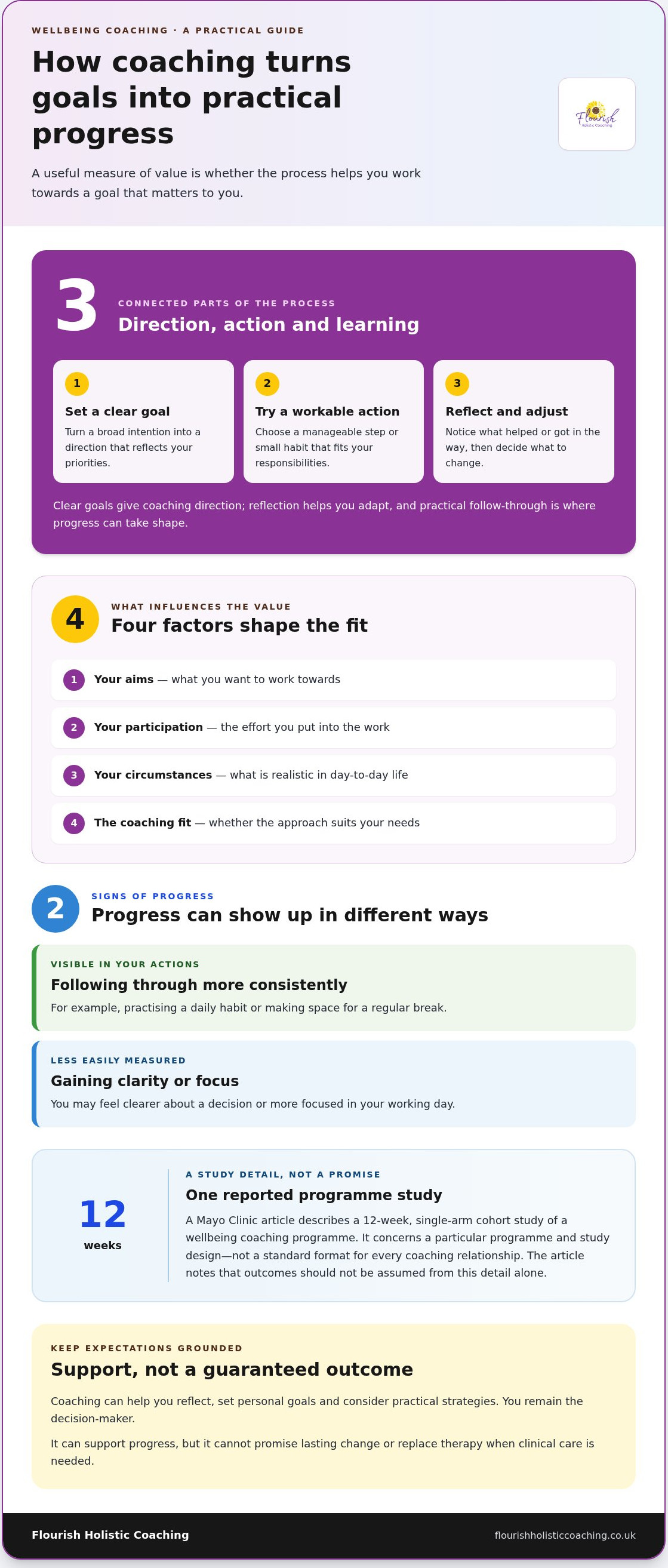
Progress might be visible, such as following through on a daily habit more consistently, or less easily measured, such as gaining clarity about a decision or feeling more focused. The key question is whether the process relates to your circumstances and whether you can see a meaningful connection between the conversations and your everyday life.
Wellbeing coaching may be worthwhile when its personalised structure helps you make progress towards a goal you value, and you’re willing to take part in the work. Its value will depend on your aims, participation, circumstances and the fit between you and the coaching approach. It can also change as your priorities develop.
What does “worth it” mean in wellbeing coaching?
Start by naming one change you hope to make. Perhaps you want to protect time for rest, bring more focus to your working day or make progress on a personal goal. A specific intention gives you something practical to reflect on, without requiring you to measure every step or judge progress only by the final outcome.
Coaching generally focuses on supporting behavioural change and personal goals. For a neutral definition of health coaching, you can explore how structured strategies may support wellbeing. Your own measure of value might include observable actions as well as broader experiences, such as feeling clearer about your choices. As your needs change, what feels worthwhile may change too.
What can coaching reasonably help you work towards?
Coaching conversations can give you space to explore habits, limiting beliefs and what gets in the way of following through. If you keep postponing a routine that matters to you, for example, you could consider what makes it difficult, whether the goal fits your current circumstances and what small next step feels manageable.
A coach can help you reflect, set personal goals and consider practical strategies, but you remain the decision-maker. Coaching doesn’t make choices for you or guarantee lasting change. It supports you as you decide what to try and review what you learn. The value is more tangible when the goals are your own and the actions are workable in your day-to-day life.
How wellbeing coaching creates value through goals, habits, and reflection
A broad intention such as “I want to feel more balanced” can be hard to act on until you define what balance means in your everyday life. A coach may help you identify what matters, then shape it into a direction you can work towards, such as creating a steadier start to the day or making space for a regular break. The goal should reflect your priorities, not someone else’s expectations.
Next, consider manageable actions that fit around your existing responsibilities. You might choose one small habit to practise, notice what interrupts it and adjust the plan if it proves unrealistic. Setting a goal is a useful beginning, but it doesn’t guarantee lasting behaviour change. Progress also depends on your circumstances, readiness and what you learn as you put the plan into practice.
How reflection can support practical progress
Regular reflection connects your intentions with what happens in practice. Look back at what felt easier than expected, which situations made follow-through harder and whether the original goal still feels right. These observations can help you spot patterns and choose a useful adjustment, rather than treating a missed step as proof that you’ve failed. A coach can add structure to this review while leaving decisions and actions with you.
Clear goals give coaching direction; regular reflection helps you adapt, and practical follow-through is where progress can take shape. This isn’t a fixed programme or a universal sequence of sessions. The focus and pace can be shaped around your priorities and adjusted as your needs change. Harvard Medical School outlines evidence-based coaching approaches as a way to support people working towards health goals. The specific process still needs to make sense for the individual.
What research can, and can’t, tell you about value
A Mayo Clinic article reports on a 12-week, single-arm cohort study of a wellbeing coaching programme. That describes a particular programme and study design, not a standard format for every coaching relationship. Without verified full results and study details, it would be unwise to draw conclusions about outcomes. Even a well-described study can’t promise that an individual will have the same experience: goals, participation and circumstances all matter.
So, is wellbeing coaching worth it? One practical way to judge is to notice whether the process helps you clarify priorities, identify workable next steps and learn from what happens between conversations. If a tailored, reflective approach feels relevant to what you want to change, explore personalised wellbeing coaching.
Wellbeing coaching compared with self-guided change and therapy
There’s more than one way to work towards change. You might prefer to set your own goals, value the structure of coaching, or need support with a clinical concern. These approaches have different purposes, so the right fit depends on what you’re looking for.
| Approach | Structure and support | Personal responsibility | Intended focus |
|---|---|---|---|
| Self-guided change | You choose resources and create your own structure. | You set, review and adapt your actions independently. | Personal goals, habits or areas you want to develop. |
| Wellbeing coaching | Collaborative conversations provide structure, reflection and tailored planning. | You make your own choices and practise actions between sessions. | Goals, habits, mindset and personal development. |
| Therapy or clinical support | Support is provided within a clinical context by an appropriately qualified professional. | You participate in a process guided by your needs and the nature of the support. | Clinical concerns, including the assessment or treatment of mental health conditions. |
When might coaching add value beyond going it alone?
Self-guided change can work well if you’re comfortable choosing what to do, tracking progress and adjusting your approach when circumstances shift. You may already have the tools and motivation you need. Coaching isn’t required to make meaningful changes.
For some people, the added value is the chance to think things through with another person, agree a practical direction, return to it regularly and reflect on what helped or got in the way. A coach may help you shape actions around your priorities, while you remain responsible for choosing and trying them. This structure can help if everyday demands make it difficult to keep sight of a goal, but it won’t suit everyone.
How is non-clinical wellbeing coaching different from therapy?
Wellbeing coaching focuses on goals, habits, mindset and personal development. It doesn’t diagnose or treat mental health conditions, and it isn’t a replacement for therapy or other clinical care. Therapy and clinical support have distinct purposes and take place within a clinical framework.
If you’re seeking help with a mental health condition or believe you need clinical care, pursue an appropriate clinical support route. Coaching may be relevant to personal goals, but it shouldn’t take the place of care for clinical needs. When considering is wellbeing coaching worth it, ask not only whether its structure suits your preferences, but whether coaching is the right kind of support for what you’re facing.
How to decide whether wellbeing coaching is worth the investment for you
A good decision starts with fit, not a promise of results. Before committing, consider what you want support with, what you’re prepared to contribute and how you’d recognise that the process is useful. This makes the decision more personal and grounded than relying on broad claims about what coaching can achieve.
Four questions to clarify your goals and readiness
- Clarify the goal. What would you like to change, and why does it matter to you now? A clear reason can help distinguish a genuine priority from something you feel you “should” work on.
- Assess your readiness. Are you open to exploring your habits and trying small actions between coaching conversations? You don’t need to have everything figured out, but a willingness to participate matters.
- Define progress. What might be different in daily life if you were moving towards your goal? You might make time for a routine, follow through more often or feel clearer about a decision. Choose practical indicators rather than relying on vague promises.
- Weigh the commitment. Consider whether you have the time, emotional capacity and energy to take part, including reflection and practice between sessions. Weigh the financial commitment against your priorities and circumstances, without assuming a particular result can be guaranteed.
Review progress without expecting a straight line
Progress can be uneven. A busy period, changing responsibilities or shifting priorities may affect what feels manageable. A pause or adjustment doesn’t automatically mean the process has failed; it can give you useful information to reflect on.
Keep brief notes on the actions you chose, what helped you follow through and what got in the way. If your aim is to build a steadier routine, notice when it felt realistic and what made it harder. These details give you something concrete to discuss and can help you decide whether to continue, adapt the action or revisit the goal.
Return to your original intention from time to time. Your needs may have changed, and a goal that once felt important may no longer be the best use of your attention. Progress isn’t a pass-or-fail judgement; it’s a way to understand what fits and what might need to change.
If your goal feels clear and you’re ready to explore a tailored approach, explore personalised wellbeing coaching.
What wellbeing coaching with Flourish can offer as a next step
Flourish Holistic Coaching offers personalised, evidence-informed wellbeing coaching for individuals and teams. The approach is non-clinical and grounded in whole-person wellbeing, with conversations shaped around your goals and circumstances. If you’re asking, “is wellbeing coaching worth it?”, consider whether this kind of tailored support fits what you want to work towards and how you’re ready to take part.
A tailored approach to personal goals and everyday habits
Your focus might be a personal or professional goal, a habit you’d like to build or a pattern of thinking that makes it harder to follow through. Coaching can give you space to explore limiting beliefs, consider practical strategies and identify actions that feel realistic in your everyday life. Your coach works alongside you, while the choices and effort remain yours.
Tracking progress can make the process more tangible. Review the actions you’ve tried, reflect on what influenced them and consider whether your next step still fits. This helps you notice movement towards your goal and adjust your approach as needed. It doesn’t promise a particular result; progress is shaped by your priorities, participation and changing circumstances.
An optional immersive format for wellbeing coaching
Flourish also offers virtual reality wellbeing coaching as an immersive coaching modality. VR environments can be part of a non-clinical coaching conversation, supporting work around emotional regulation, mindset, habits, fears and phobias in a controlled setting. The technology is a format for coaching, not a clinical intervention, and its relevance depends on your goals and preferences.
Flourish’s coaching can support you to explore focus, habits, mindset and emotional regulation, but it doesn’t diagnose or treat mental health conditions and isn’t a substitute for clinical care. If a tailored, collaborative approach feels relevant to what you want to develop, explore wellbeing coaching with Flourish.
Choose the support that fits your next step
So, is wellbeing coaching worth it? It may be when the process supports progress towards a goal that matters to you and its structure fits your circumstances. Clear goals, reflection and practical actions can help you assess whether coaching is useful. Self-guided change may suit you if you prefer to set and review your own steps. Coaching is non-clinical, so it isn’t a substitute for clinical support when that’s what you need.
Flourish Holistic Coaching offers personalised, evidence-informed support focused on individual goals and practical strategies. Sessions may explore mindset, emotional regulation, focus and daily habits, with progress shaped by your participation and needs. Virtual reality wellbeing coaching is also available as an immersive coaching modality. Neither approach guarantees a particular result; the value lies in whether it feels relevant to what you want to work towards.
If this approach feels like a considered fit for your goals, explore wellbeing coaching with Flourish.
Frequently Asked Questions
Is wellbeing coaching worth it?
Wellbeing coaching may be worth it if it gives you useful structure for working towards a goal that matters to you. Its value might show in practical steps, such as following through on a chosen habit, or in greater clarity about your priorities. Consider your readiness to take part and whether the approach fits your circumstances. Coaching can support progress, but it can’t guarantee a particular result.
What can wellbeing coaching help with?
Wellbeing coaching can help you explore personal or professional goals, mindset, focus, emotional regulation and everyday habits. You might look at what makes a positive routine difficult to maintain, explore beliefs that affect your choices or consider practical ways to follow through on a goal. Coaching offers space to reflect and plan, but you decide which actions to take and put them into practice.
How do I know if wellbeing coaching is right for me?
It may suit you if you have a goal you’d like to work towards and are open to reflecting, making choices and practising actions between conversations. Consider what you want to change, why it matters now and what progress might look like in daily life. Coaching is non-clinical, so if you’re seeking support for a mental health condition, clinical care may be more appropriate.
Can wellbeing coaching guarantee lasting change?
No. Wellbeing coaching can’t guarantee lasting change or a specific outcome. A coach can help you clarify goals, explore habits and identify practical strategies, but progress depends on your participation, circumstances and whether the approach suits your needs. Plans may need to shift as life changes. Treat coaching as structured support for your own efforts, rather than a promise that change will happen automatically.
How is wellbeing coaching different from therapy?
Wellbeing coaching focuses on personal development, goals, habits, mindset and wellbeing. It doesn’t diagnose or treat mental health conditions, and it isn’t a substitute for therapy or other clinical support. Therapy and clinical care have different purposes and address clinical needs. If you’re looking for assessment or care for a mental health condition, seek an appropriate clinical support route rather than relying on coaching for that purpose.
How can I tell whether wellbeing coaching is helping?
Agree practical signs of progress that relate to your goal, then review them regularly. Note which actions you tried, what made them easier or harder and whether your priorities have changed. Progress may include small shifts in habits, focus or clarity rather than a dramatic result. Use what you notice as information for discussion and adjustment, not as proof that you’ve succeeded or failed.
Article by
Shelley Perry-Clarke
After 30 years of working as a mental health nurse and therapist (no longer practicing), I have honed my skills and focused on coaching as an empowering approach to change which assumes that the individual is the expert on themselves. I am passionate about coming alongside others and being a companion and catalyst for change on the journey towards a destination that you perhaps didn't know was possible. Through an integrative and holistic (whole person) lense and using NLP, CBC (Cognitive Behavioural Coaching), Solution Focused Coaching, Mindfulness, Motivational Enhancement techniques, Neuroscience, Poly Vagal Theory and education I present to you as a Professional Life Coach & Mindset and Behaviour Change Specialist, Trainer, and Public Speaker. I am an Expert by Experience in Eating Disorders, ADHD, Endometriosis, PMOS and Fybromyalgia; I am an Advocate for (w)holistic wellbeing and true recovery. I am experienced, knowledgeable and well versed in trauma, Autism, PDA amongst others. I am a Multi-Award Winning Professional. But most importantly, I am a mum, a grandma (to a dog as well as beautiful little girl) and try to live a faith based Christian life, with respect and acceptance of other humans with other faiths and beliefs. I am simply a human. I love flowers, and reading and hanging out with friends.
Disclaimer
The information provided on this blog is for educational and informational purposes only and is not intended as medical advice. It should not be used to diagnose, treat, cure, or prevent any health condition. Always seek the advice of a qualified healthcare professional with any questions you may have regarding a medical condition or before starting any new health regimen. Never disregard professional medical advice or delay seeking it because of something you have read here. Reliance on any information provided on this blog is solely at your own risk.

