
What if progress begins not with a sweeping life change, but with a clearer understanding of what’s shaping your day-to-day choices?
If holistic coaching feels broad, or you’re unsure whether sessions lead to practical steps, you may be asking, “how does holistic coaching work?” It connects your circumstances, goals and everyday actions rather than treating one goal in isolation. Reflection can help you identify what matters now. From there, you can consider manageable actions, review what you learn and adjust your direction as needed.
This guide walks through the stages of a holistic coaching process, from understanding your context to choosing realistic next steps. It also explains how Flourish Holistic Coaching uses Maslow’s Hierarchy of Needs as a model for wellbeing while keeping the focus individual and practical. You’ll get a clearer sense of whether this kind of support fits your goals and circumstances, without expecting a quick fix.
Key Takeaways
- Holistic coaching considers how different parts of life can influence wellbeing, habits and personal goals.
- Explore how does holistic coaching work in practice, from reflecting on your circumstances to choosing actions and reviewing what you learn.
- Coaching can provide structure and personalised support, but it can’t guarantee a particular result or suit every situation.
- Consider your goals, preferred kind of support and readiness for change when deciding whether coaching feels relevant.
- Flourish uses Maslow’s Hierarchy of Needs as a model for wellbeing within its personalised, non-clinical coaching approach.
How does holistic coaching work as a whole-person process?
Wellbeing, habits, priorities and goals can influence one another. A demanding period at work, for example, may disrupt routines and leave you with less energy for a personal goal. So, how does holistic coaching work? It offers a collaborative, non-clinical space to explore the wider context around what matters to you, then consider a direction that fits your circumstances.
Coaching supports people to clarify their aims and consider ways forward. Holistic coaching applies that process with attention to the person as a whole, rather than treating one goal as separate from everyday life. You can read more about the wider field of Coaching.
This short video offers another perspective on a related form of coaching:
What does a whole-person approach consider?
Relevant areas of life might include routines, relationships, work, rest, priorities, mindset and personal goals. These are context, not a compulsory checklist. The aim isn’t to examine everything at once, but to notice which areas connect with the focus you want to explore.
Hypothetical example: imagine you want to make time for a personal project but often feel too tired to begin. Looking at your routines and current demands may help you identify what’s getting in the way and consider a manageable adjustment. This is an illustration, not a promised result.
Flourish’s Coaching Approach uses Maslow’s Hierarchy of Needs as a model for wellbeing. It can frame a personalised conversation about what supports your wellbeing and where you’d like to focus, without assuming everyone has the same priorities.
What is the coach’s role?
A coach can ask thoughtful questions, help you clarify what matters and support you to consider possible next steps. The process is collaborative, not a set of instructions or a one-size-fits-all plan. You bring your knowledge of your life; the coach helps create space to reflect and find direction.
You remain the decision-maker. You choose whether to try an action, what feels appropriate and manageable, and whether it still fits as your circumstances change. A structured development process can provide focus and opportunities to review your thinking, but it can’t guarantee a particular outcome. Progress is personal, and the direction remains yours.
What happens in holistic coaching, from reflection to action?
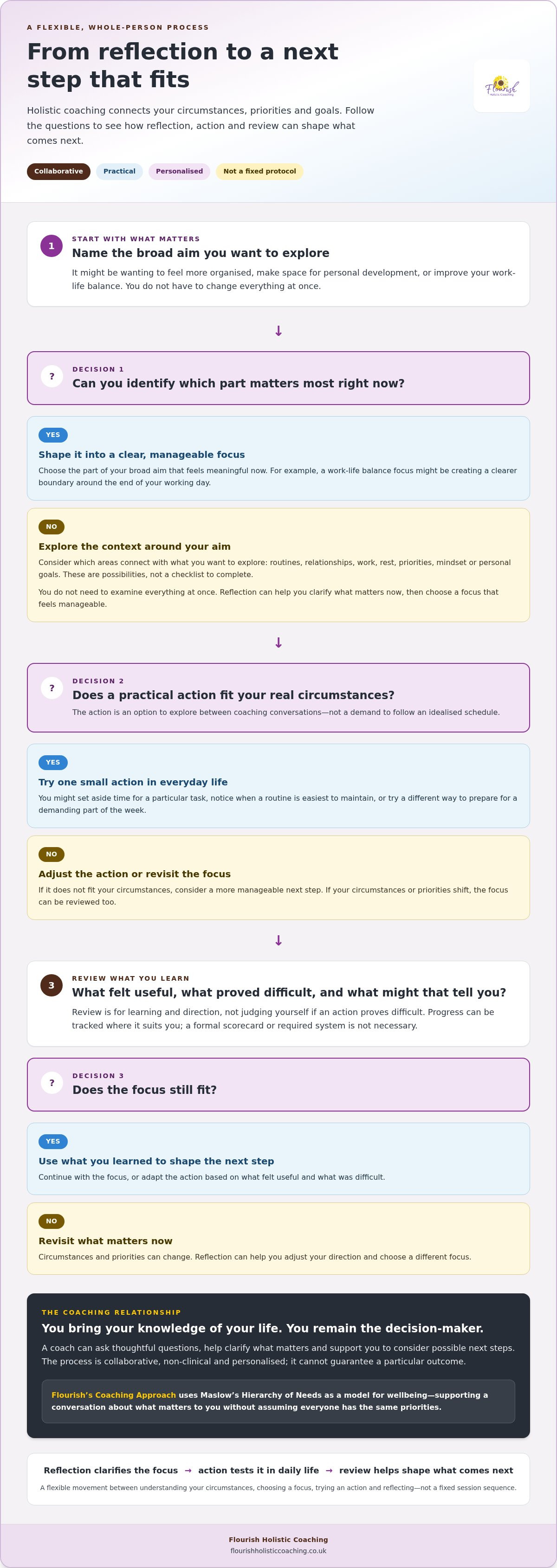
There isn’t one sequence that suits everyone. A useful way to picture the process is as a flexible movement between understanding your circumstances, choosing a focus, trying an action and reflecting on what you learn. This is an explanatory model, not a fixed session protocol. The pace and emphasis can be shaped around you and your priorities.
That makes the answer to “how does holistic coaching work?” more practical. Reflection connects a broad intention to a step that makes sense in everyday life. Reviewing what happens helps you learn from the experience and adapt your focus.
How are a coaching focus and goals agreed?
A conversation may begin with a broad aim, such as wanting to feel more organised or make space for personal development. Exploring what’s happening in your daily life can help you identify which part of that aim matters most now. You and your coach can shape it into a clearer focus that feels meaningful and manageable, rather than trying to change everything at once.
For example, if you want to improve your work-life balance, you might first focus on creating a clearer boundary around the end of your working day. That focus isn’t a permanent commitment. If your circumstances or priorities shift, you can review and adjust it.
How can small actions and review support progress?
Once you have a focus, you might choose one practical action to explore between coaching conversations. That could mean setting aside time for a particular task, noticing when a routine is easiest to maintain, or trying a different way to prepare for a demanding part of the week. The action should fit your real circumstances, not an idealised schedule.
At a later review, you can consider what felt useful, what proved difficult and what that tells you about a next step. Progress towards personal goals can also be tracked where it suits you, but that needn’t mean a formal scorecard or required system. The purpose is to support learning and direction, not to judge you if an action proves difficult.
Reflection clarifies the focus, action tests it in daily life, and review helps shape what comes next. This steady cycle can keep coaching grounded while leaving room for changing needs. If you’d like to explore whether this kind of support fits your goals, you can book a Discovery Call.
Does holistic coaching work, and what can it realistically offer?
Holistic coaching can provide structure for reflection, goal-setting and considering practical next steps. It can’t guarantee a particular result. Progress depends on your goals, circumstances, participation and whether the approach feels like a good fit. So, how does holistic coaching work in practice? It can support a considered process of change while leaving decisions and outcomes with you.
Evidence-informed practice means drawing on relevant knowledge to guide the coaching approach. It doesn’t prove that the same method will suit everyone or that a particular outcome will follow. People bring different priorities, resources and challenges, so a focus that feels useful to one person may need adapting for another.
What can coaching support without promising?
In Flourish’s non-clinical coaching, possible areas to explore include wellbeing, mindset, focus, emotional regulation, habits and personal or professional goals. These are potential coaching topics, not assured outcomes. For example, you might explore what affects your focus, consider a small change to your routine and then reflect on whether it suits your circumstances. That process can provide structure, but it doesn’t guarantee improved focus or any other result.
Claims about the effectiveness of coaching more broadly need reliable evidence and clear context. Without that, it’s more accurate to describe what coaching may involve than to promise what it will achieve. A supportive process can help you clarify your own direction, but its value and impact will vary from person to person.
How is non-clinical coaching different from therapy?
Flourish provides non-clinical coaching, not therapy or counselling. Coaching can focus on personal development and goals, but it isn’t a substitute for clinical assessment or treatment. If you’re considering the distinction in more detail, read our article on coaching and therapy. Keeping this boundary clear helps you decide whether coaching matches the kind of support you’re looking for.
Coaching can support change; it can’t guarantee change. That distinction leaves room for both ambition and realism. You can explore what matters, consider possible actions and decide what feels right for you without treating a particular result as certain. If you’d like to discuss whether personalised wellbeing coaching fits your goals, you can book a Discovery Call.
How can you tell whether holistic coaching fits your situation?
Deciding whether coaching feels suitable can take a little reflection. You don’t need to arrive with a fully formed goal, and it’s reasonable to feel unsure while you work out what kind of support might be useful. If you’re still wondering “how does holistic coaching work?”, consider whether you’d value a collaborative conversation to explore your circumstances and choose practical next steps.
What questions can help clarify whether coaching feels right?
Start with what you’d like to understand, change or work towards. Your answer might be specific, such as building a routine that supports a personal goal, or more open, such as wanting to understand what gets in the way of feeling balanced. Either can be a starting point for reflection.
It may also help to consider the kind of support you prefer. Coaching is collaborative: you bring your perspective, and the coach can help you clarify priorities and explore possible actions. Ask yourself whether this feels like a useful way to work. You might also consider whether you’d like to review your goals as you go, since priorities and circumstances can shift.
- What would I like to understand or work towards?
- Would reflective, practical conversations suit the way I prefer to approach change?
- What would help me recognise whether my focus still feels relevant?
You don’t have to know every answer before exploring the idea. A clearer sense of your hopes, preferences and questions can develop over time.
When might clinical support be more appropriate?
Holistic coaching is non-clinical. It doesn’t provide clinical assessment or treatment, and it isn’t a replacement for those forms of care. If you’re looking for help with a health concern that calls for clinical assessment or treatment, appropriate healthcare support is the relevant route. This distinction isn’t a judgement about what you’re experiencing; it clarifies the purpose and scope of coaching.
Coaching may be relevant when you want to explore personal development, habits, mindset, focus or goals. If you’re weighing up the difference between coaching and therapy, our guide to coaching vs therapy offers a fuller comparison. Take time to consider which kind of support best matches what you’re seeking.
If collaborative, personalised support feels relevant to your goals, book a Discovery Call to explore holistic wellbeing coaching with Flourish.
How does Flourish put its holistic coaching approach into practice?
Flourish offers personalised, evidence-informed, non-clinical coaching for individuals and teams. The approach considers the wider context around your goals, including the habits, priorities and circumstances that may shape your wellbeing. If you’re asking how holistic coaching works at Flourish, the focus is on exploring what matters to you and tailoring coaching around that, without promising a particular result.
How does Flourish use Maslow’s Hierarchy of Needs?
Flourish’s Coaching Approach uses Maslow’s Hierarchy of Needs as a model for wellbeing. It offers a way to reflect on different aspects of your life and consider what feels important at a particular time. It isn’t a diagnostic tool or a rigid checklist, and it doesn’t assume that everyone’s needs or priorities follow the same pattern.
For a fuller explanation of how the model relates to coaching, explore our article on coaching and Maslow’s Hierarchy of Needs.
What can Flourish coaching focus on?
Depending on your aims and circumstances, coaching may explore mindset, habits, focus, emotional regulation or personal and professional goals. These are possible areas of focus, not promised outcomes. For instance, if you’re working towards a professional goal, you might reflect on the routines and priorities that influence how you approach it. The coaching focus can be shaped around what feels relevant to you.
Individual coaching programmes are personalised rather than identical for everyone. The process may include clarifying a goal, considering practical actions and reviewing what you learn, with the direction guided by your priorities. Flourish also offers Virtual Reality Wellbeing Coaching, a separate non-clinical service. Its guide explains that option in more detail.
Everyday life is personal, so support should be considered in context. If you’d like to explore whether Flourish’s holistic wellbeing coaching fits your goals, book a Discovery Call.
Take a steady next step towards your goals
Holistic coaching connects your goals with the wider context of your life. It can help you reflect on what matters and consider manageable actions. Progress can be explored and reviewed over time, but no approach can guarantee a particular outcome. The right kind of support depends on your needs.
So, how does holistic coaching work at Flourish? It begins with a personalised, evidence-informed, non-clinical approach that uses Maslow’s Hierarchy of Needs as a model for wellbeing. Coaching can offer space to explore priorities, habits and goals while you remain in charge of the choices you make.
Flourish provides personalised wellbeing coaching for individuals and teams. If you’d like to discuss whether it feels relevant to your circumstances, book a Discovery Call.
You can take your time, bring your questions and begin with the goal that feels most meaningful to you.
Frequently Asked Questions
How does holistic coaching work in practice?
Holistic coaching starts by exploring what matters to you and the circumstances around your goals. You and your coach can then agree a focus, consider manageable actions and reflect on what you learn. The process is adapted to the individual rather than following a guaranteed formula. Flourish’s personalised approach is non-clinical, and you remain involved in decisions about your direction and next steps.
What happens during a holistic coaching session?
A session may involve discussing current priorities, reflecting on habits or challenges, and considering a practical next step. The format can vary according to you and your programme, so there isn’t one structure for every conversation. Flourish’s coaching is personalised and non-clinical. It isn’t therapy or counselling, and it doesn’t provide clinical treatment.
Can holistic coaching help you change habits?
Habits can be a focus of holistic coaching, including Flourish’s work to support positive daily habits. You might reflect on what helps you maintain a routine, what tends to interrupt it, and whether a manageable action feels realistic in your circumstances. Reviewing what you learn can inform a next step, but coaching can’t guarantee that a habit will change.
Is holistic coaching the same as therapy?
No. Holistic coaching and therapy are not interchangeable. Flourish provides non-clinical coaching, which may focus on wellbeing, habits, mindset or personal goals, but doesn’t provide therapy, counselling, diagnosis or treatment. If you’re seeking clinical assessment or treatment, seek appropriate healthcare support. The right kind of support depends on what you need, and coaching shouldn’t be treated as a substitute for clinical care.
How long does holistic coaching take to work?
There’s no single timeline that applies to everyone, and responsible coaching shouldn’t promise quick or fixed results. Progress may depend on your goals, circumstances, the actions you choose and how well the coaching focus fits your needs. A personalised process can include reflecting on what you’ve learnt and adapting possible next steps, rather than measuring progress against a universal number of sessions.
Can holistic coaching support emotional regulation?
Emotional regulation can be a focus of Flourish’s non-clinical coaching. Conversations may offer space to reflect on your responses and consider practical ways to support your wellbeing, based on your goals and circumstances. This isn’t treatment for a mental health condition, and coaching doesn’t replace clinical care. The focus is personal development, without promising a particular change or outcome.
What happens if my goals change during holistic coaching?
Your goals can be revisited if your circumstances or priorities change. You and your coach can reflect on what you’ve learnt, consider whether the original focus still feels relevant and explore different next steps. You remain involved in those choices, so there’s no need to stay with a goal that no longer fits. To talk through whether personalised coaching suits your aims, book a Discovery Call.
Article by
Shelley Perry-Clarke
After 30 years of working as a mental health nurse and therapist (no longer practicing), I have honed my skills and focused on coaching as an empowering approach to change which assumes that the individual is the expert on themselves. I am passionate about coming alongside others and being a companion and catalyst for change on the journey towards a destination that you perhaps didn't know was possible. Through an integrative and holistic (whole person) lense and using NLP, CBC (Cognitive Behavioural Coaching), Solution Focused Coaching, Mindfulness, Motivational Enhancement techniques, Neuroscience, Poly Vagal Theory and education I present to you as a Professional Life Coach & Mindset and Behaviour Change Specialist, Trainer, and Public Speaker. I am an Expert by Experience in Eating Disorders, ADHD, Endometriosis, PMOS and Fybromyalgia; I am an Advocate for (w)holistic wellbeing and true recovery. I am experienced, knowledgeable and well versed in trauma, Autism, PDA amongst others. I am a Multi-Award Winning Professional. But most importantly, I am a mum, a grandma (to a dog as well as beautiful little girl) and try to live a faith based Christian life, with respect and acceptance of other humans with other faiths and beliefs. I am simply a human. I love flowers, and reading and hanging out with friends.
