
In a world where modern life frequently feels fragmented across demanding professional duties, personal relationships, and everyday physical demands, many people find themselves seeking a more unified way to manage their personal growth. You might be eating well yet struggling with cognitive exhaustion at work, or pursuing ambitious professional milestones while feeling unmoored in your emotional habits and daily routines. When standard approaches treat these experiences as isolated dilemmas, progress often feels disjointed and unsustainable.
This is where holistic wellbeing coaching offers a grounded, integrative alternative. Rather than viewing individual habits in isolation, this practice explores how your physical vitality, cognitive mindset, emotional regulation, and daily environments continuously interact to shape your overall sense of wellness. Understanding what is holistic wellbeing coaching begins with recognising that sustainable personal development rarely emerges from quick fixes or rigid protocols; rather, it grows from examining the broader context of your everyday life and clarifying practical, client-led actions that respect your personal agency.
Key Takeaways: What You Need to Know
- Whole-Person Focus: Holistic wellbeing coaching examines the dynamic connections between your habits, emotional landscape, mindset, and life context rather than isolating a single symptom or goal.
- A Grounded Wellness Model: Structured coaching often uses developmental frameworks, such as Maslow’s Hierarchy of Needs, to establish steady physical and emotional foundations before pursuing aspirational milestones.
- Strictly Non-Clinical: Coaching is a forward-focused, non-clinical partnership that does not diagnose, treat, or replace professional therapy, counselling, or psychiatric healthcare.
- Individual Autonomy: You retain complete agency over your priorities; coaching does not prescribe a universal lifestyle checklist, but helps you identify realistic, sustainable steps suited to your circumstances.
What Is Holistic Wellbeing Coaching? A Whole-Person Definition
To understand holistic wellbeing coaching, it is helpful to contrast it with narrower personal development methods. Traditional coaching models often focus exclusively on discrete performance outcomes—such as reaching a sales target, completing a training regime, or organising a crowded schedule—frequently ignoring the underlying energy, emotional climate, and personal relationships that sustain or hinder those efforts. Holistic coaching, by comparison, broadens the lens to consider the person as an integrated ecosystem.
Definition: Holistic wellbeing coaching is a collaborative, goal-focused, and non-clinical practice that supports individuals in understanding how their mindset, physical habits, emotional regulation, and environmental pressures interact. By evaluating these interconnected elements together, coach and client co-create sustainable strategies that cultivate equilibrium, build resilience, and move purposefully towards meaningful life goals.
Crucially, the word “holistic” does not imply that every dimension of your life is in disrepair or requires equal attention at all times. Such an expectation would be overwhelming and counterproductive. Instead, a holistic orientation simply means that whatever goal you bring to a session is not evaluated in an artificial vacuum. If you wish to improve your daily focus at work, a holistic coach will not merely hand you a time-management calendar; they will invite you to observe how your restorative sleep, boundaries around technology, self-critical inner dialogue, and evening decompression routines all influence your ability to concentrate during working hours.
Furthermore, holistic wellbeing coaching is deeply grounded in individual autonomy. It avoids dogmatic lifestyle prescriptions, moralistic notions of “wellness,” or one-size-fits-all routines. A practitioner acts not as an omniscient authority figure dictating how you ought to live, but as an empathetic, objective sounding board and reflective guide. Together, you observe unhelpful patterns, explore alternative perspectives, and design manageable, iterative experiments in daily living that align with your unique values, responsibilities, and pacing.
What does “whole-person wellbeing” mean?
In everyday conversation, the word “wellbeing” is frequently reduced to physical health metrics or momentary feelings of happiness. However, whole-person wellbeing represents a more comprehensive, dynamic equilibrium across multiple overlapping domains of human existence:
- Physical vitality: Foundational routines including restorative sleep, conscious movement, balanced nourishment, and physical recovery that establish the biological baseline for energy and cognitive clarity.
- Emotional regulation and awareness: The capacity to notice, understand, and navigate internal emotional states without becoming overwhelmed, developing steady strategies to soothe nervous system stress.
- Cognitive and mindset patterns: The prevailing internal narratives, beliefs, and perceptual filters that influence how one interprets challenges, setbacks, and personal capability.
- Social and interpersonal connections: The quality of one’s relationships, boundaries, communication habits, and sense of belonging within families, workplaces, and broader communities.
- Vocational and purposeful alignment: How everyday actions, work responsibilities, and creative pursuits connect with an individual’s deeper values and personal sense of purpose.
In practice, these domains are in constant conversation with one another. Consider a modest, everyday example: a working professional experiences persistent afternoon fatigue and attributes it entirely to an uninspiring workload. Through holistic exploration, they might recognise that their afternoon slump is actually compounded by fragmented sleep, erratic hydration, an unspoken boundary conflict with a colleague that causes chronic low-grade anxiety, and a harsh internal critic that demands perfection in every task. By acknowledging these interrelated layers, the client gains the freedom to address the real root of their fatigue rather than attempting to solve a multi-layered challenge with sheer willpower alone.
What is the purpose of wellbeing coaching?
The primary purpose of holistic wellbeing coaching is to cultivate sustained self-awareness and practical self-efficacy. Rather than promising instant transformation or effortless self-actualisation, coaching creates a calm, structured space where you can pause, step back from the rush of daily demands, and observe your life with compassionate objectivity.
Within this reflective container, you and your coach work collaboratively to untangle the habitual assumptions and behavioural loops that may be keeping you feeling stuck, fatigued, or unfulfilled. The process fosters agency by helping you:
- Clarify genuine priorities: Separate your own authentic desires and values from the external expectations, social comparisons, and internalized pressures that often clutter decision-making.
- Identify leverage points: Discover which modest, targeted adjustments in your daily rhythms can generate the most meaningful positive ripple effects across your overall lifestyle.
- Develop self-regulatory capacity: Learn practical techniques to stabilise your attention, manage emotional responses calmly, and respond deliberately rather than reacting impulsively to stressors.
- Establish realistic accountability: Build steady, iterative habits that can be evaluated and adapted over time, treating setbacks not as personal failures, but as valuable feedback.
Ultimately, wellbeing is experienced as an evolving, personal balance rather than a static scorecard. A holistic coach helps you construct a lifestyle architecture that supports your resilience through life’s inevitable changes, ensuring that your pursuits are supported by stable inner foundations.
How Holistic Wellbeing Coaching Connects Goals, Habits and Life Context
Human behaviour does not occur in an emotional or environmental vacuum. When we attempt to introduce a new habit—such as a morning meditation practice, a regular exercise routine, or a structured evening wind-down—our success is governed by the ecosystem of our current responsibilities, mental attitudes, and physiological states. When a goal continually falls flat, the issue is rarely a lack of personal character or determination; more often, the goal was set without accounting for the context in which it must live.
Holistic wellbeing coaching works by making these invisible connections clear. A coach assists you in mapping out the circular relationship between your beliefs, emotional responses, and behavioural habits:
- Beliefs shape perceptions: A deeply held, unconscious belief that “rest must be earned through exhaustion” leads to overcommitting and neglecting personal boundaries.
- Perceptions influence emotions: Feeling perpetually behind triggers sustained feelings of overwhelm, guilt, and emotional vigilance.
- Emotions drive automatic habits: In an attempt to soothe chronic stress, one might turn to evening doom-scrolling, late-night snacking, or avoidance behaviours that disrupt restorative sleep.
- Habits reinforce beliefs: Waking up exhausted, one feels less capable and more stressed, which seemingly validates the initial belief that one cannot afford to rest.
By bringing thoughtful, non-judgemental attention to these reciprocal loops, coaching allows you to intervene at multiple points in the cycle, making lasting habit change significantly more achievable.
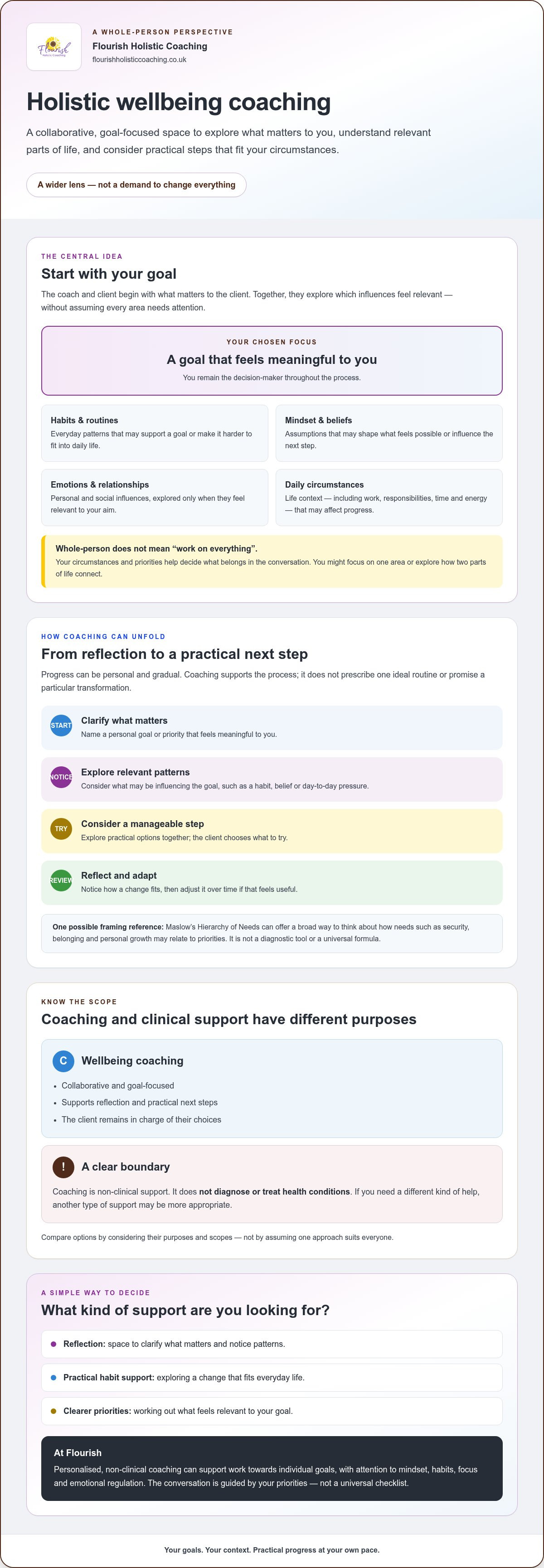
The Flourish Coaching Model: Maslow’s Hierarchy of Needs as a Wellness Framework
To provide a structured, evidence-informed foundation for this exploration, Flourish Holistic Coaching utilises Maslow’s Hierarchy of Needs as an applied wellness model. Originally developed by psychologist Abraham Maslow, this framework illustrates how human motivation naturally progresses from fundamental foundational stability toward higher-order creativity, purpose, and self-actualisation. In our coaching practice, this hierarchy serves as a practical diagnostic map, ensuring we do not build ambitious lifestyle goals upon unstable personal foundations.
Maslow’s Hierarchy as a Holistic Wellness Progression:
- Physiological Equilibrium (The Foundation): Restorative sleep patterns, balanced nutrition, hydration, nervous system regulation, and regular movement. Coaching ensures that physical depletion is addressed before demanding significant cognitive shifts.
- Safety and Environmental Stability: Daily routines, financial boundaries, predictable emotional safe spaces, manageable workloads, and healthy physical environments that reduce continuous fight-or-flight triggers.
- Belonging and Relational Connection: Authentic interpersonal relationships, supportive social networks, clear relational boundaries, and effective communication habits that nurture emotional connection.
- Esteem, Competence, and Self-Trust: Cultivating internal self-worth, reframing limiting beliefs, developing focus, dismantling harsh inner self-criticism, and experiencing tangible mastery in personal and professional pursuits.
- Self-Actualisation and Purpose: Aligning daily life with personal ethics, engaging in creative expression, contributing meaningfully to one’s community, and pursuing aspirational life goals from a place of grounded stability.
Using Maslow’s framework prevents the common pitfall of attempting high-level habit redesign while operating in foundational survival mode. For instance, if an individual presents with a desire to achieve “self-actualised” career milestones (Level 5) but is contending with erratic sleep, poor nourishment (Level 1), and a chronic feeling of workplace insecurity (Level 2), coaching gently guides attention back to stabilising the base of the pyramid first. When physiological and psychological safety needs are nurtured, the capacity for emotional regulation, creative problem-solving, and sustainable motivation naturally expands.
Which areas might a coaching conversation explore?
Because the coaching relationship is entirely tailored to your lived experience, sessions are not bound by a rigid, predetermined curriculum. Instead, conversations explore the specific areas that are most relevant to your stated focus. Common domains include:
- Emotional regulation and nervous system steadiness: Discovering grounded techniques to down-regulate acute stress, release somatic tension, and respond calmly to unexpected workplace or family disruptions.
- Mindset shifts and limiting beliefs: Examining subconscious assumptions, imposter phenomena, perfectionism, or catastrophic thinking patterns that hold you back from taking confident action.
- Focus, attention, and cognitive clarity: Designing environmental and digital boundaries to protect mental clarity, reduce chronic multitasking, and deepen meaningful productivity.
- Rhythms and intentional habits: Structuring morning and evening transitions that conserve energy, support natural circadian rhythms, and make positive choices the path of least resistance.
- Navigating fears and everyday phobias: Gently exploring non-clinical anxieties, performance hesitation, or situational worries using cognitive reframing and structured exposure strategies.
Throughout these explorations, a professional coach remains mindful never to pathologise normal human struggles. Experiencing distraction, occasional fatigue, or uncertainty about the future are natural aspects of navigating modern life, not symptoms of personal brokenness.
How can a whole-person perspective make goals more realistic?
Traditional goal-setting methodologies often treat objectives as purely linear equations: set a target, apply discipline, and measure the outcome. However, real life rarely cooperates with such sterile plans. Family emergencies emerge, work projects surge unpredictably, and energy fluctuates across seasons and circumstances.
A whole-person perspective introduces ecological validity to your goals. In coaching, an ecologically sound goal is one that harmonises with the real realities of your existing life—your time commitments, financial constraints, parenting duties, and emotional bandwidth. When a goal is designed with your full life context in mind:
- Actions are scaled down to manageable, consistent increments that do not trigger burnout or operational resistance.
- Friction points are anticipated in advance—such as planning what to do when you have a chaotic travel schedule or low physical energy.
- Success is redefined around steady consistency and progress rather than rigid, unbending perfection.
By ensuring that your aspirational desires respect your foundational human needs, holistic coaching transforms personal development from an exhausting chore into a sustainable, restorative way of living.
Holistic Wellbeing Coaching vs Therapy: Understanding the Boundaries
As the personal development field grows, one of the most vital distinctions to understand is the clear, ethical boundary between holistic wellbeing coaching and clinical therapeutic care. Because both modalities involve reflective, one-to-one conversations centred on personal growth, mindset, and emotional experiences, it is easy for those new to the space to confuse the two.
However, holistic wellbeing coaching is strictly a non-clinical service. It is neither intended as, nor should it ever be presented as, a substitute for counselling, psychotherapy, psychiatric diagnosis, or clinical mental health treatment. Maintaining clarity around these professional boundaries is essential for your safety, ensuring that you receive the appropriate standard of care for your specific circumstances.
| Dimension | Holistic Wellbeing Coaching | Clinical Therapy / Counselling |
|---|---|---|
| Core Objective | Facilitating self-awareness, personal growth, habit creation, and intentional progress toward life goals. | Diagnosing, treating, and healing clinical psychological disorders, trauma, and acute mental distress. |
| Temporal Orientation | Primarily present- and forward-looking; examining how current habits shape future outcomes. | Often involves extensive exploration of past experiences, childhood wounds, and psychological origins. |
| Practitioner Scope | Collaborative guide, strategic thinking partner, and accountability facilitator. Non-clinical. | Licensed, registered healthcare professional qualified to assess and treat mental illness. |
| Client Capacity | Assumes the client possesses adequate psychological stability to engage in reflective action and habit design. | Designed to support individuals navigating functional impairment, psychological suffering, or crisis. |
| Medical Authority | Does not diagnose, prescribe, or provide clinical treatment interventions. | Operates within healthcare frameworks; may diagnose and provide clinical protocols. |
What does wellbeing coaching offer, and what is outside its scope?
Within its appropriate scope, holistic wellbeing coaching provides an exceptionally effective, empowering partnership. It offers practical tools for structuring everyday routines, building emotional regulation strategies, cultivating cognitive focus, and learning how to align daily behaviours with long-term aspirations. It is an ideal space for exploring who you want to become and how you intend to navigate the practical realities of getting there.
Conversely, ethical coaches clearly communicate what lies beyond their remit. Holistic wellbeing coaching does not:
- Provide clinical psychiatric or psychological assessments, nor offer formal diagnostic labels.
- Deliver treatment protocols for clinical depression, severe anxiety disorders, complex trauma (PTSD/C-PTSD), active eating disorders, or substance dependencies.
- Conduct deep, trauma-processing therapy aimed at resolving unresolved developmental or psychological injury.
- Advise on, manage, or alter prescribed psychiatric or medical medications.
At Flourish Holistic Coaching, all services are strictly non-clinical. If during the coaching journey it becomes evident that a client is experiencing clinical distress or psychological impairment that requires medical or therapeutic intervention, our practice prioritises ethical responsibility by recommending an evaluation by an appropriately credentialed healthcare professional.
How can someone decide what kind of support to seek?
If you are feeling uncertain about whether your current situation calls for coaching or clinical therapy, it can be helpful to pause and honestly appraise your current baseline of functional wellbeing:
- When therapy is recommended: If you are struggling to get through the day, experiencing debilitating panic, feeling overwhelmed by intrusive traumatic memories, managing prolonged periods of profound emotional numbness, or finding that your basic capacity to work and care for yourself is severely impaired, clinical therapy or counselling is the safest, most supportive initial pathway. In these circumstances, an experienced mental health professional provides the specialised clinical care needed to re-establish safety and stability.
- When coaching is well-suited: If you are fundamentally functioning well in your day-to-day life, but feel uninspired, energetically depleted, reactive under pressure, stuck in unhelpful habit loops, or eager to establish more intentional lifestyle structures, holistic wellbeing coaching can provide the structure, clarity, and non-clinical strategies to help you thrive.
In many instances, individuals who have successfully completed therapy in the past find that wellbeing coaching serves as a wonderful subsequent chapter, offering a proactive, forward-looking space to practice daily wellness habits in the present.
How to Tell Whether Holistic Wellbeing Coaching Fits Your Goals
Embarking on a personal coaching engagement is an investment of time, focus, and vulnerability. Determining whether this modality aligns with your immediate goals requires thoughtful reflection on what kind of support you actually need right now.
Coaching is fundamentally an active, participatory process. Rather than a passive consultation where answers are handed down, it demands a willingness to self-reflect, question familiar assumptions, and carry out small behavioural experiments between sessions. The following step-by-step considerations can help you assess your readiness:
- Identify your primary desire: Clarify whether you are seeking resolution for deep emotional suffering and past events (which indicates a need for therapy) or whether you are looking for structured strategies to cultivate habits, resilience, and personal focus in your current life (which points toward coaching).
- Evaluate your emotional bandwidth: Reflect on whether you have sufficient baseline energy to engage in constructive, forward-focused exploration. Coaching works best when you have the capacity to take intentional, gradual steps in your daily routines.
- Acknowledge a desire for partnership: Consider whether you are open to an objective sounding board who will ask thought-provoking questions, gently challenge limiting assumptions, and encourage personal accountability.
- Embrace steady, incremental change: Confirm that you are seeking sustainable, lifelong habits rather than an overnight, dramatic fix. Sustainable wellbeing develops through consistent, patient iteration.
What questions can you ask before choosing a coach?
The coaching industry encompasses a wide spectrum of approaches, qualifications, and styles. Choosing a practitioner who embodies professional integrity, maintains clear ethical boundaries, and resonates with your communication style is paramount. Consider asking the following questions during an initial enquiry:
- “How would you describe your coaching philosophy and framework?” Look for clear, structured answers that reference grounded methodologies—such as whole-person frameworks or Maslow’s Hierarchy of Needs—rather than vague, mystical, or purely motivational promises.
- “What are the boundaries of your practice, and how do you handle clinical concerns?” A reputable coach will speak comfortably and transparently about what they do not do, articulating a clear policy for referring clients to clinical professionals if clinical needs arise.
- “How do you tailor your sessions to individual circumstances?” Ensure that the coach listens to your unique life context rather than forcing you into a rigid, predetermined template.
- “How do we monitor and review whether our work together is effective?” Ask how goals are articulated, how progress is observed, and how sessions are adapted if a particular approach does not feel helpful.
How might you recognise steady progress?
Because holistic wellbeing encompasses internal shifts as well as outward actions, measuring progress looks quite different from ticking off traditional performance metrics. Progress in holistic coaching is rarely a straight upward line; instead, it tends to show up through quiet, meaningful shifts in your day-to-day lived experience:
- Increased self-awareness: You begin to notice the early physical and emotional cues of stress or fatigue before reaching a state of complete exhaustion, allowing you to pause and recalibrate proactively.
- Reduced emotional reactivity: When confronted with unexpected challenges or interpersonal tension, you notice an expanded space between stimulus and response, choosing deliberate action over habitual, defensive reactions.
- Compassionate self-talk: Your internal narrative becomes less punishing. When routines slip or mistakes occur, you respond with curious reflection rather than harsh self-criticism.
- Habit consistency over perfection: Rather than abandoning a positive routine because life disrupted it for a day, you calmly return to your practices without guilt or drama.
- Greater alignment: Your daily choices increasingly reflect your genuine values, leaving you with a deeper sense of physical vitality and personal integrity.
Holistic Wellbeing Coaching at Flourish: Personalised, Non-Clinical Support
At Flourish Holistic Coaching, we offer evidence-informed, non-clinical coaching tailored specifically to help individuals and professional teams move beyond cycles of chronic overwhelm, mental fatigue, and fragmented habits. Our practice is built on the conviction that meaningful, lasting personal growth happens when individuals are supported with warmth, structured clarity, and deep respect for their personal autonomy.
We work with adults who are ready to examine their personal ecosystem thoughtfully. Rather than presenting abstract theories or generic wellness advice, Flourish provides a calm, reflective partnership where you can untangle unhelpful behavioural patterns, build robust daily routines, and make steady, measurable progress toward your personal and professional aspirations.
What does Flourish Holistic Coaching focus on?
Rooted in our applied whole-person wellness model—grounded in the principles of Maslow’s Hierarchy of Needs—Flourish structures its programmes to cultivate lasting internal stability and tangible everyday competence. Whether working one-to-one or delivering specialised programmes for corporate teams, our coaching focuses on five interconnected areas of personal development:
- Mindset and Belief Re-patterning: We help clients identify and compassionately reframe limiting beliefs, chronic self-doubt, and the subconscious internal narratives that impede progress. By fostering psychological flexibility, clients cultivate a resilient, realistic inner voice.
- Emotional Regulation and Stress Resilience: Coaching introduces practical, non-clinical techniques to manage physiological stress responses, soothe anxiety, and develop emotional steadiness during demanding life transitions.
- Focus, Clarity, and Attention Management: In an era of non-stop digital interruption, we work together to design restorative cognitive boundaries, enhance deep working focus, and reduce the mental scatter of daily multitasking.
- Habits and Daily Rhythms: We co-create sustainable daily rituals that support foundational vitality—from sleep hygiene and balanced nourishment to intentional morning transitions—ensuring that your lifestyle reliably supports your energy needs.
- Addressing Fears and Mild Phobias: Using supportive cognitive strategies, we help clients confront and reframe everyday situational fears, public speaking apprehensions, and non-clinical phobias in a controlled, supportive manner.
All Flourish coaching services are provided strictly as non-clinical support. We do not provide therapy, counselling, psychotherapy, or treatment for mental health conditions, maintaining an uncompromising standard of professional clarity and client safety at all times.
Where does virtual reality wellbeing coaching fit?
Alongside our traditional one-to-one and team coaching sessions, Flourish offers an innovative, non-clinical modality: Virtual Reality (VR) Wellbeing Coaching. This modern approach incorporates immersive virtual environments into the coaching process to support emotional regulation, habit change, and mindset work.
Within a controlled, immersive VR setting, clients can step into soothing, restorative virtual landscapes designed to encourage physiological relaxation and mindful presence. Furthermore, VR environments offer an experiential canvas for non-clinical habit rehearsal, situational confidence building, and gently addressing mild fears or everyday phobias in a safe, guided space. By combining cutting-edge immersion with grounded coaching principles, VR sessions provide a powerful, experiential modality to complement your overall wellbeing journey—whilst remaining entirely non-clinical and complementary to your self-directed growth.
Frequently Asked Questions
What is holistic wellbeing coaching?
Holistic wellbeing coaching is a collaborative, non-clinical partnership that examines an individual's personal goals through the lens of their whole life—including mindset, physical habits, emotional regulation, and daily environments. By recognising how these domains interact, a coach helps you design realistic, sustainable routines that foster balance, resilience, and personal clarity. It does not diagnose, treat, or replace medical or clinical healthcare.
What happens in a holistic wellbeing coaching session?
In a typical session, you and your coach explore your chosen priorities, review recent successes or challenges, and examine the underlying patterns influencing your daily progress. Sessions often involve clarifying values, reframing limiting assumptions, learning practical stress-regulation strategies, and co-creating manageable, actionable experiments to test between meetings. The agenda is always led by your goals, within a calm, non-judgemental environment.
Is holistic wellbeing coaching the same as therapy?
No. Coaching is an entirely non-clinical service focused on present self-awareness, future aspirations, and daily habit design. Therapy and counselling are clinical healthcare services delivered by licensed professionals to diagnose, treat, and resolve psychological disorders, deep-seated trauma, and severe emotional distress. Coaches do not provide psychological diagnoses or clinical treatments, referring clients to healthcare practitioners whenever clinical needs arise.
Can holistic wellbeing coaching help with habits and mindset?
Yes. Mindset and habit formation are primary focal points of holistic coaching. By exploring how your subconscious assumptions, emotional responses, and daily environments influence your choices, coaching helps you dismantle persistent unhelpful loops. Through small, steady, and structured adjustments, you learn to establish positive daily habits that align with your long-term goals without burning out.
Who can benefit from holistic wellbeing coaching?
Holistic wellbeing coaching is ideally suited for adults who possess baseline psychological stability but feel uninspired, energetically depleted, overwhelmed by stress, or stuck in unhelpful patterns. Whether navigating a significant life transition, seeking better emotional regulation, or wanting to align daily habits with personal values, individuals who value personal autonomy and reflective, proactive growth can benefit significantly.
How do I choose the right holistic wellbeing coach?
Begin by clarifying what you hope to achieve and whether your needs are non-clinical. Look for coaches who clearly define their professional boundaries, demonstrate grounded methodologies (such as Maslow’s Hierarchy of Needs or evidence-informed habit models), and avoid unrealistic outcome promises. Schedule an initial enquiry to observe whether their communication feels calm, respectful, transparent, and aligned with your personal values.
Taking the Next Step in Your Wellbeing Journey
Cultivating genuine, lasting wellbeing is not about achieving an elusive state of effortless perfection; it is about building a compassionate, grounded relationship with yourself and the rhythms of your daily life. When you stop treating your energy, mindset, emotions, and goals as separate, competing priorities, you unlock the ability to make deliberate, sustainable progress that endures through life's changing seasons.
By rooting your personal growth in a stable foundation—nurturing basic physiological vitality and emotional safety before expecting peak performance—you create an internal ecosystem where resilience, focus, and authentic purpose can genuinely thrive. A skilled holistic coach walks alongside you through this unfolding process, offering structured guidance, practical tools, and an objective sounding board as you design a life that feels balanced from the inside out.
If you are ready to explore how a personalised, whole-person approach can support your mindset, habits, and emotional regulation, we invite you to take a calm, considered next step. Explore holistic wellbeing coaching with Flourish and discover how our non-clinical individual, team, and virtual reality coaching programmes can support your journey toward sustainable personal equilibrium.
Article by
Shelley Perry-Clarke
After 30 years of working as a mental health nurse and therapist (no longer practicing), I have honed my skills and focused on coaching as an empowering approach to change which assumes that the individual is the expert on themselves. I am passionate about coming alongside others and being a companion and catalyst for change on the journey towards a destination that you perhaps didn't know was possible. Through an integrative and holistic (whole person) lense and using NLP, CBC (Cognitive Behavioural Coaching), Solution Focused Coaching, Mindfulness, Motivational Enhancement techniques, Neuroscience, Poly Vagal Theory and education I present to you as a Professional Life Coach & Mindset and Behaviour Change Specialist, Trainer, and Public Speaker. I am an Expert by Experience in Eating Disorders, ADHD, Endometriosis, PMOS and Fybromyalgia; I am an Advocate for (w)holistic wellbeing and true recovery. I am experienced, knowledgeable and well versed in trauma, Autism, PDA amongst others. I am a Multi-Award Winning Professional. But most importantly, I am a mum, a grandma (to a dog as well as beautiful little girl) and try to live a faith based Christian life, with respect and acceptance of other humans with other faiths and beliefs. I am simply a human. I love flowers, and reading and hanging out with friends.
